

If your feed looks anything like mine, you’ve probably seen it – post after post telling you that heavy lifting is the only way to build strength.
That if you’re not in the gym lifting heavy, you’re not getting results.
And maybe part of you wondered, “is that true?”
So let’s talk about it. Because the answer is more nuanced than the internet wants you to believe.
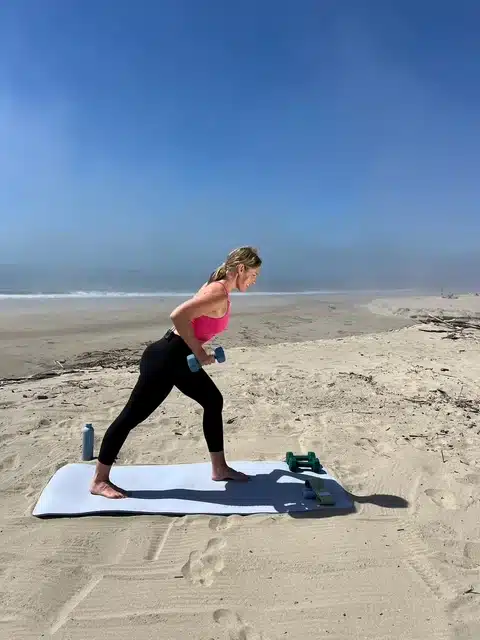
It’s no secret that Pilates is my foundation.
Pilates strengthens your core, restores alignment, builds body awareness, and teaches you how to move well.
It develops the kind of body awareness that makes every other form of exercise more effective and more sustainable. And it has truly transformed my body.
If Pilates is your foundation too, you might be wondering how this all fits together.
Do you need to add weights? Is Pilates enough? Let’s get into it…
What we know for sure: building muscle is essential to good health.
Maintaining and building muscle is one of the most important things you can do for your health as you age, especially in your 40s and beyond.
We start losing muscle mass as early as age 30, and that rate accelerates in perimenopause and menopause.
Research shows that women can lose 3–8% of their muscle mass per decade after 30, with losses accelerating significantly after 60. And you can feel it before you can see it.
What that translates to in real life:
- lower energy
- slower metabolism
- less bone density
- increased risk of injury
- a body that feels harder to live in
Muscle isn’t just about movement. It’s an organ and the health of that organ has a direct impact on your metabolism, your energy, and how you feel day to day.
Which means maintaining it doesn’t just happen on its own. We have to actively work for it.
Everyday life doesn’t challenge our muscles and bones the way it used to.
Joseph Pilates wrote about this back in 1945 and it’s striking how much more true it is today than when he first said it.
He opened his book with the line: “Civilization impairs physical fitness.”
He was dedicated to helping people fight back against the way our lifestyle was impairing our physical health.
That was 80 years ago!
Before smartphones and desk jobs became the norm. Before we started spending hours a day hunched over screens.
If he thought modern life was getting in the way of our bodies back then, imagine what he’d say now.
Dr. Vonda Wright, orthopedic surgeon and author of Unbreakable, says, “Aging to frailty only seems normal because modern life made it so.”
The point is, we have to actively work against our lifestyle these days.

We MUST challenge our muscles and bones in order to build strength.
And that word bones matters more than most people realize.
Bone is living tissue. It responds to stress and challenge by remodeling and growing stronger – but only if we give it a reason to.
Without that stimulus, bone density declines. This is why weight-bearing and resistance exercise isn’t just good for your muscles, it’s essential for your bone health too.
What’s the most well-studied way to build muscle? Progressive overload.
When people say “progressive overload” they’re referring to consistently and gradually increasing the challenge to your muscles over time.
The same principle applies to bone. It needs progressive challenge to adapt and strengthen.
But lifting extremely heavy weights isn’t the only way to increase challenge. It can also happen with:
- Resistance bands
- Bodyweight training
- Reformer Pilates
- Moderate weights with higher rep ranges
The mechanism matters more than the method.
Your muscles don’t know if you’re using a barbell, bodyweight or a resistance spring, they just know they’re being challenged.
Using heavy weights is one of the most direct (and well-studied) ways to progressively challenge your muscles, which is why it’s recommended particularly for women in midlife and beyond.
It can be intimidating though! A quick scroll through Instagram will tell you:
“If you’re not lifting heavy, you’re not building strength.”
“Heavy weights are the ONLY way to build muscle and stay strong.”
So it’s normal to wonder if you’re doing enough and if you should be doing more.
Should every woman be lifting heavy? Not exactly.
This is where the blanket advice we hear online starts to break down and where I want you to feel permission to think about your body and your situation.
When people say “lift heavy,” they’re often referring to a specific style of training:
- low reps (think 4–6)
- maximum load
- pushing to full muscle exhaustion (the point where you can barely finish your last rep)
For some women, that’s a great fit. But for most, it’s something to work up to, but not a great starting point.
Jumping into heavy weight training at max exertion without the right foundation can actually do more harm than good.
Here are a few things to consider before jumping into lifting heavy weights:
Pelvic Floor Health: Many women (especially postpartum) are dealing with some degree of pelvic floor dysfunction without even realizing it.
Heavy lifting puts significant downward pressure on the pelvic floor, and without proper function and alignment restored first, that load can contribute to prolapse, leakage, or worsening symptoms.
Pilates is uniquely positioned to address this. It’s one of the most effective tools for restoring pelvic floor function and building the internal support your body needs which is why I recommend Pilates as a foundational form of exercise, especially if you want to lift heavy weights.
Joint Hypermobility: Some women are naturally more flexible and mobile in their joints, which can actually make them more vulnerable to injury under heavy loads without proper stabilization and control first. It doesn’t mean you can’t lift heavy, it just means you need to have a solid foundation first.
Joint and connective tissue changes: As estrogen declines in perimenopause and menopause, so does its protective effect on our joints and ligaments.
This means our connective tissue becomes less elastic and more vulnerable to strain – which is why women in their 50s often find that jumping into heavy lifting leads to nagging aches and injuries that take far longer to heal than they used to.
While your muscles might feel ready, your connective tissue may not be. Starting small and building a strong foundation first is key.
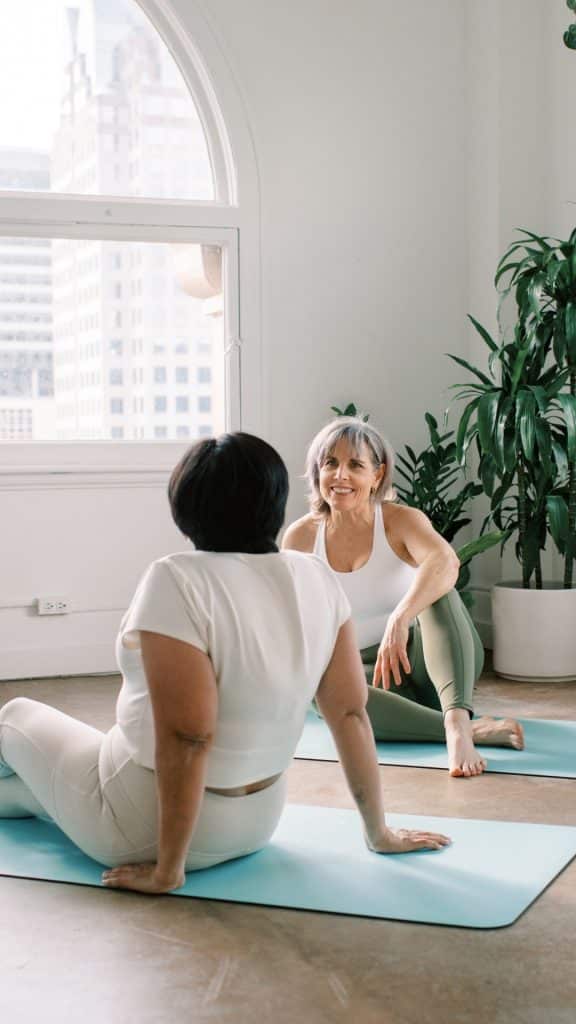
Osteoporosis or Low Bone Density: While resistance training is beneficial for bone health, certain high-load exercises can increase fracture risk for women who haven’t been evaluated and aren’t working with proper guidance.
If you’re over 50, you want to have a clear picture of your bone health before diving into a heavy lifting routine.
I pay $100 for a Dexa at a local clinic once per year. A quick online search can help you find one in your area or you can request a Dexa scan (or similar) from your doctor.
Post-Injury or Post-Surgical Recovery: Jumping into heavy lifting before your body has fully rehabilitated isn’t just uncomfortable, it’s a setup for re-injury.
It can be hard to take time off if exercise is part of your routine, but the healthiest thing for your body is to take time to recover and to return with patience and care.
My recommendation? Start with Pilates. Rebuild your foundation. Notice how you feel as you progress and build from there.
High Stress + High Cortisol: This one doesn’t get talked about enough. For women in perimenopause or high stress seasons – already navigating elevated cortisol, very high-intensity training can actually add to the stress load on your body, making recovery harder and hormonal symptoms worse.
Sometimes training smarter means training a little lighter – at least for a season.
I don’t share these to dissuade you from lifting heavy weights, simply to remind you that you need to consider your unique body and season of life as you start a new form of exercise.
If you fall into a category above, lifting heavy weights can absolutely still be a part of your routine, you just need a solid foundation and a thoughtful progression.

Here’s what my own routine looks like in this season:
You know I’m big on seasons of life and my routine changes based on my health, stress levels, work schedule, kids’ ages and many other factors.
Pilates is my foundation in every season, and right now I do a combination of Pilates and weight lifting.
With weights, I’m focusing on progressive overload – aiming to lift 2-4x per week focusing on lower body, upper body and full body routines. I do basic weight training exercises and simply add more weight or reps over time to ensure I’m continually challenging myself.
While lifting, I keep my Pilates foundations in mind: breath, control, precision, core connection.
I do Pilates at home (usually 10-30 minutes at a time) to ensure I’m strengthening muscles that weight lifting doesn’t target, maintaining core strength, caring for my spine, improving my posture and preventing injury.
The mind-body connection and body awareness built in Pilates makes every other form of exercise more effective.
The goal is to work smarter, not just harder.
Pilates strengthens your core, restores alignment, builds body awareness, and teaches you how to move well, which is exactly what you need before you layer in heavier loading.
The more connected and in tune you are with how your body feels when it moves, the more you can challenge yourself safely when you decide to add heavier weights.
At Lindywell, our Pilates programming helps you move well so you can build real, lasting strength in a way that feels good and supports your life for years to come.
Our Pilates-Inspired Weight Training series in the Lindywell app is designed to help you safely progress in your weight lifting, while keeping your Pilates principles in mind to reduce risk of injury and help you feel your best.
Should every woman challenge her muscles and build strength?
Yes, absolutely!
Should every woman follow the “lift heavy no matter what” advice flooding your feed?
Not without context and definitely not without considering your unique body and where you are right now.
Wherever you find yourself (just starting out, coming back after a break, or trying to figure out what your body needs in this season) you’re in the right place.
You deserve guidance that actually considers you and your unique situation – not a one-size-fits-all trend and that’s what we are here to help you with at Lindywell. 💛
If you have additional questions about weight training or Pilates, comment on this post. I may use your question in an upcoming blog post.
Ready to experience Pilates and weights working together? Join us for the Never Felt Better Challenge – a free 5-day Pilates and weights program you can do from home. It kicks off March 16th. Click here to join us!
Sources:
How to Age Stronger in Menopause: 5 Lessons from Orthopedic Surgeon Dr. Vonda Wright
Unbreakable by Dr. Vonda Wright
Wolfe RR, American Journal of Clinical Nutrition, 2006



3 thoughts on “Should You Be Lifting Heavy Weights?”
Love these Wednesday wellness emails. Thank you! Today’s post is just what I needed.
If I’m in the season of life where I want to build more strength by adding heavier weights but want to be sure I have the right foundation through Pilates do I simply go through the classes that pop up each M-F on the app or should I target the classes with weights. I’m 66 with osteopenia and have suffered several hip/back injuries trying to build strength. I hope this question makes sense. Thank you for your guidance. I’ve been a member since 2021. Love the Lindywell app.
Interesting article. I read the article linked in the sources and she seems to take a less nuanced approach, “lifting heavy is a prescription.”
What is considered a heavy weight?